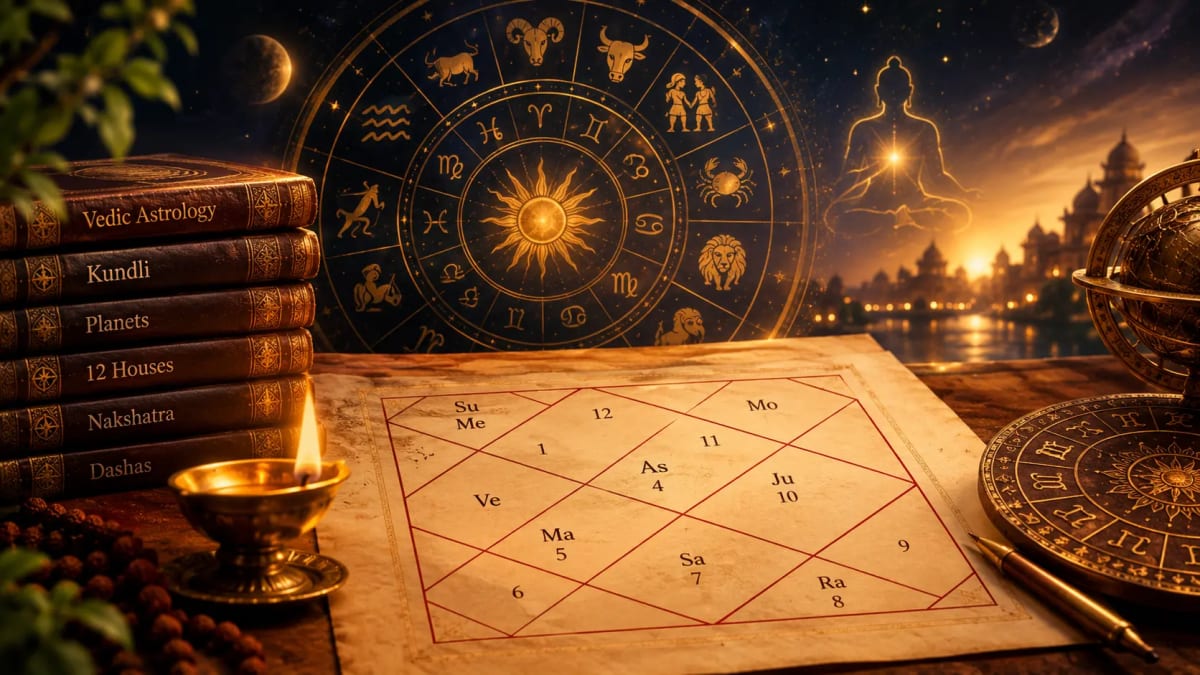
When you first look at a Kundli, it can seem confusing. You may see a diamond-shaped or square chart filled with numbers, planet abbreviations, zodiac signs and unfamiliar terms such as Lagna, Bhava, Nakshatra and Dasha. The good news is that you do not need to become an astrologer to understand the basics.
A Kundli, also called a Kundali or Vedic birth chart, is traditionally used in Vedic astrology to represent the planetary positions associated with the time and place of birth. Learning how to read Kundli starts with understanding a few building blocks: the Ascendant or Lagna, the 12 houses, the zodiac signs, the planets, and the timing systems used in astrology.
In this beginner's guide, we will walk through a simple order for reading a birth chart. The goal is not to make a complete prediction from one placement, but to help you understand what you are looking at and ask better questions about your own Kundli.
What Is a Kundli?
A Kundli is a traditional Vedic astrology birth chart calculated from your birth date, birth time and birthplace. It represents the sky at that moment using a chart containing 12 houses, zodiac signs and planetary placements.
The chart is best understood as a system rather than a collection of isolated predictions. A planet tells you what type of energy is being considered, a sign gives context to how that energy is expressed, and a house shows the area of life being examined.
For example, Mars is traditionally associated with action, courage and assertiveness. Mars in a particular house may therefore be interpreted in relation to the life area represented by that house. The final interpretation depends on the sign, house lord, aspects and the rest of the chart.
What Do You Need Before Reading a Kundli?
Accurate birth information is important when creating a Vedic birth chart. You generally need three details:
- Date of birth: The day, month and year you were born.
- Exact birth time: The closer the recorded time is to your actual birth time, the more useful it is for calculating the Ascendant and house structure.
- Birthplace: The city or location where you were born, because location affects the astronomical calculation.
Birth time deserves special attention because the Ascendant changes over time. If your recorded time is uncertain, treat detailed house-based interpretations cautiously.
Step 1: Find Your Lagna or Ascendant
The first place to start when learning how to read a Kundli is the Lagna, also called the Ascendant or rising sign. It is the zodiac sign traditionally associated with the eastern horizon at the time of birth.
The Lagna establishes the first house and therefore provides the framework for reading the other houses. Once you know the Ascendant, you can count the remaining houses in order.
The Lagna is often used in Vedic astrology when examining personality, physical tendencies, life direction and the overall structure of the birth chart. It is one of the most important starting points for a beginner.
Step 2: Understand the 12 Houses in Your Kundli
The 12 houses are one of the most important parts of Kundli reading. Each house is traditionally associated with different areas of life.
- 1st house: Self, personality, identity and overall approach to life.
- 2nd house: Family, speech, accumulated resources and values.
- 3rd house: Communication, skills, courage, siblings and effort.
- 4th house: Home, comfort, mother, emotional foundations and property.
- 5th house: Creativity, learning, children, intelligence and interests.
- 6th house: Service, routines, competition, obstacles and responsibilities.
- 7th house: Marriage, partnerships and one-to-one relationships.
- 8th house: Transformation, shared resources, research and deeper change.
- 9th house: Higher learning, beliefs, teachers, fortune and long-distance journeys.
- 10th house: Career, work, reputation, achievement and public responsibilities.
- 11th house: Gains, networks, friendships, ambitions and long-term goals.
- 12th house: Expenses, retreat, privacy, foreign connections and release.
These are traditional associations rather than fixed guarantees. An empty house is not automatically a bad sign, and a planet in a house should not be interpreted without considering the sign and house lord.
Step 3: Identify the Planets in Your Birth Chart
After finding the houses, look at the planets placed in them. In Vedic astrology, the nine commonly used Grahas are the Sun, Moon, Mars, Mercury, Jupiter, Venus, Saturn, Rahu and Ketu.
Each has traditional meanings:
- Sun: Identity, confidence, authority and vitality.
- Moon: Emotions, mind, habits and responsiveness.
- Mars: Action, courage, drive and competitiveness.
- Mercury: Communication, reasoning, learning and analysis.
- Jupiter: Wisdom, growth, guidance and beliefs.
- Venus: Relationships, attraction, comfort, art and pleasure.
- Saturn: Discipline, responsibility, patience and long-term effort.
- Rahu: Ambition, desire, experimentation and unconventional themes.
- Ketu: Detachment, introspection, spirituality and unusual areas of focus.
Do not stop at the planet's basic meaning. The same planet can be interpreted differently depending on its sign, house, lordship, aspects, conjunctions and strength.
Step 4: Understand the Zodiac Signs
The 12 zodiac signs, or Rashis, provide another layer of meaning. They describe the style or environment in which a planet operates.
For a beginner, one useful way to think about the three main building blocks is:
- Planet: What energy or function is being represented?
- Sign: How is that energy expressed?
- House: Where in life is that energy being experienced?
For example, instead of saying only “Mars is important,” a fuller description considers Mars in a specific sign and house and then checks its relationship with the rest of the chart.
Step 5: Learn About House Lords
One of the next steps in Kundli reading is understanding the lord of each house. Every house is associated with a zodiac sign, and each sign has a planetary ruler in traditional Vedic astrology.
The position of that ruling planet can add important context. For example, if you are studying the seventh house for marriage, you can look at the sign occupying the seventh house and then find where its ruling planet is placed.
This is more advanced than simply reading planets in houses, but it is one of the ideas that helps you move from a basic birth chart reading toward a more complete Vedic astrology interpretation.
Step 6: Look at Planetary Aspects and Conjunctions
Planets do not operate completely independently. Traditional Vedic astrology also considers aspects, known as Drishti, and conjunctions where multiple planets occupy the same house or sign.
An aspect can connect one part of a chart with another. A conjunction can bring the themes of two or more planets together. These relationships can change how a placement is interpreted.
For beginners, the important lesson is simple: do not make a major conclusion from one planet without checking what other planets are doing around it.
Step 7: Understand Your Moon Sign and Nakshatra
The Moon is another important reference point in Vedic astrology. Your Moon sign is the zodiac sign where the Moon is placed in the birth chart. It is traditionally associated with the mind, emotions, habits and subjective experience.
You may also see a term called Nakshatra. The zodiac is traditionally divided into 27 Nakshatras, or lunar constellational divisions. The Moon's Nakshatra can provide another layer of interpretation and is also important in some traditional timing systems.
For a beginner, you do not need to memorise all 27 Nakshatras immediately. Start by locating your Moon sign and Nakshatra, then learn their meanings gradually.
Step 8: Learn What Dashas Mean
If you want to go beyond basic Kundli reading, you will eventually encounter Dasha systems. Dashas are traditional planetary periods used in Vedic astrology to examine timing.
One commonly used system is Vimshottari Dasha. It assigns periods to planets according to a traditional sequence. Astrologers use these periods alongside the birth chart and other timing factors when discussing when certain themes may become more prominent.
A Dasha should not be interpreted as a guaranteed event calendar. It is one layer of a larger astrological framework.
North Indian and South Indian Kundli Charts
If you compare Kundlis from different parts of India, you may notice that the charts look completely different. This can be confusing at first, but the underlying information can represent the same zodiac, houses and planetary positions.
The North Indian style is commonly drawn as a diamond-based chart, while the South Indian style uses a square layout. The main difference is how houses and signs are arranged visually.
Do not assume that one format is more accurate simply because it looks different. The important thing is learning how to identify the Lagna, signs, houses and planetary placements in the format you are using.
How to Read a Kundli Without Getting Confused
The biggest beginner mistake is trying to interpret everything at once. A better method is to follow the same order every time.
- Find the Lagna or Ascendant.
- Identify the 12 houses and what they represent.
- Note which planets are in each house.
- Identify the zodiac sign of each important planet.
- Check the relevant house lords.
- Look for major conjunctions and aspects.
- Check the Moon sign and Nakshatra.
- Study the relevant Dasha for timing.
- Combine the information instead of relying on one placement.
This approach makes Kundli reading more systematic and reduces the chance of jumping to conclusions from a single planetary placement.
What Not to Do When Reading Your Birth Chart
Astrology content online often presents short statements such as “Saturn in this house means this” or “Mars in that house guarantees that.” These statements can be too simplistic.
A birth chart contains interacting factors. The same planet can have different meanings depending on the Ascendant, sign, house, lordship, aspects and timing.
It is also better to avoid fear-based interpretations. A challenging placement does not mean that a person's future is fixed or that a negative event is guaranteed.
Use a Kundli as a traditional framework for understanding patterns and asking questions rather than as a reason to make decisions based on fear.
How Yogi AI Can Help You Read Your Kundli
Learning the basics of Vedic astrology can take time because a Kundli contains many layers. Yogi AI is designed to make those layers easier to explore through conversational Kundli guidance.
You can ask questions about your Lagna, planets, houses, marriage indicators, career themes, Nakshatra, Dashas and other parts of your birth chart using everyday language.
Instead of searching for separate explanations of every Sanskrit term, you can explore your questions step by step and use the conversation to understand how different parts of a chart connect.
The purpose is not to reduce a complete birth chart to one prediction. It is to help you understand traditional Vedic astrology concepts in a simpler and more accessible way.
Final Thoughts
Learning how to read your Kundli does not require memorising everything on day one. Start with the Lagna, understand the 12 houses, identify the planets and signs, and then gradually learn house lords, aspects, Nakshatras and Dashas.
The most important principle is to read the chart as a whole. One planet, one house or one Dosha should not be treated as a complete description of your life.
Once you understand the basic structure, your Kundli becomes much easier to explore. You can then move from simply looking at symbols on a chart to asking more meaningful questions about relationships, career, personal strengths, timing and other areas traditionally examined through Vedic astrology.
FAQs
What is a Kundli?
A Kundli is a traditional Vedic astrology birth chart calculated from a person's birth date, birth time and birthplace. It represents planetary positions using signs and houses.
How do I start reading my Kundli?
Start with your Lagna or Ascendant. Then identify the 12 houses, the planets placed in them, their zodiac signs, and the relevant house lords.
What is the most important house in a Kundli?
There is no single house that is always the most important. The Lagna and houses connected to the question being studied are especially important. For example, the seventh house is traditionally examined for marriage and partnerships, while the tenth house is important for career.
Why is accurate birth time important?
Birth time helps determine the Ascendant and house structure of the chart. If the time is significantly inaccurate, house-based interpretations may change.
What is a Dasha in Vedic astrology?
A Dasha is a traditional planetary period used for timing in Vedic astrology. It is interpreted together with the birth chart rather than as a guaranteed event calendar.
Can I read my own Kundli?
Yes. You can learn the basics yourself by understanding the chart structure, houses, planets and signs. More advanced interpretation requires studying how these factors interact.